


How Americans Struggle To Keep Older Loved Ones Safe Online

Hari Ravichandran
CEO and Founder of Aura
Hari Ravichandran is the CEO and founder of Aura, with over 40 approved or pending technology patents to his name. He was recognized by Forbes magazine as one of the most powerful CEOs 40 and Under in 2014 and 2015. Hari holds an MBA from the Wharton School at the University of Pennsylvania and a BS in Computer Engineering from Mississippi State University.
Reviewed by Alina Benny

Alina Benny
Aura Cybersecurity Editor
Alina Benny leads organic content at Aura, covering the gamut of security topics for the company, including online safety, identity theft, and fraud. Before Aura, she oversaw part of Nextiva’s marketing efforts. She holds a bachelor's degree in Electronics Engineering from the Cochin University of Science and Technology and has nearly a decade in content marketing. Twitter: @heyabenny
Aura's Trusted Family Access gives caregivers consent-based visibility into a senior loved one's safety alerts. New survey data shows why families need it.

.svg)


Older Americans lost $7.7 billion to fraud last year
People 60 and older reported roughly $7.7 billion in fraud losses to the FBI last year, up 59% from the year before, and impersonation's one of the reasons why. In a July alert, the agency warned that scammers were posing as staff of its own Internet Crime Complaint Center, calling people who'd already been defrauded and offering to help recover their money. It’s now the top scam targeting senior citizens this year.
Caregivers are dealing with these scams alongside their aging loved ones, and AI is only making that harder.
That's why Aura built Trusted Family Access: it lets a trusted family member, with the loved one's consent, see and help respond to the alerts on that person's Aura account.
What Aura’s Trusted Family Access does
Trusted Family Access gives one adult on an Aura plan consent-based visibility into another adult's safety alerts. The caregiver sends an invitation naming what they'd like to help with. The loved one sets up their own profile, accepts or declines the request, and can change their sharing permissions at any time.
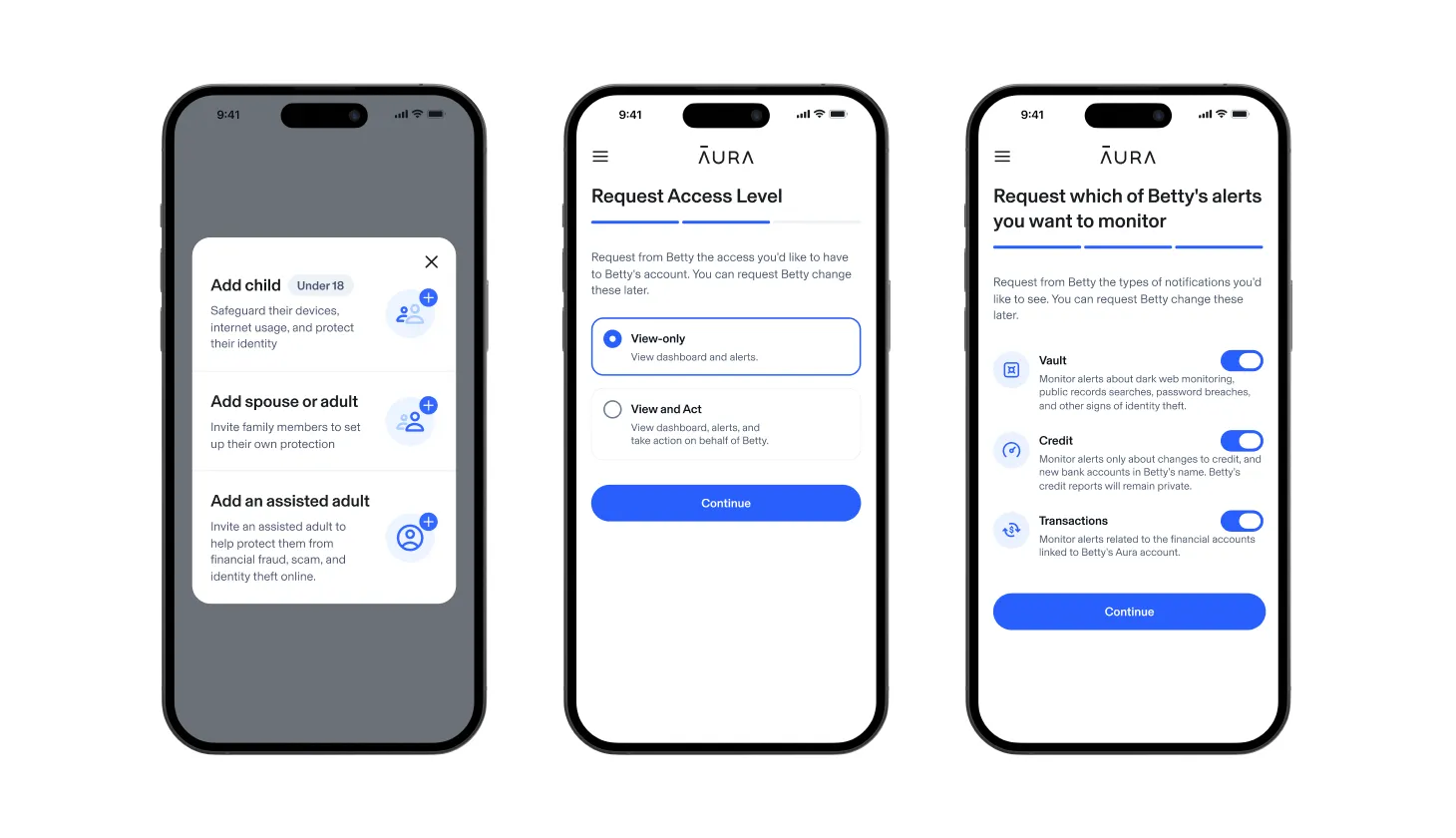
- The caregiver can view alerts for the loved one's credit, financial transactions, and Vault, on the web or in the mobile app.
- Credit alerts are view-only: the caregiver sees them but cannot act on them, and credit reports stay private even when credit alerts are shared.
- For financial transactions and saved passwords, the loved one can grant a second level of access, view and act, which lets the caregiver update passwords or adjust what's being monitored on their behalf.
- The dashboard shows alerts and settings. It doesn't show browsing history or activity, and no caregiver can take credit actions such as freezes or disputes on a loved one's behalf.
- Everything lives in the caregiver's existing Aura dashboard, under My Family.
Who can use it
Trusted Family Access is included with Aura's Couple and Family plans, which cover two and five adults. An individual member can move to a Couple plan to cover one senior loved one, and each added adult can have one caregiver.
Two in three families saw a scam attempt last year
65% of caregivers say an aging loved one experienced a scam or fraud attempt in the past 12 months, according to a Talker Research survey of 2,000 U.S. adults ages 40–60 caring for an aging loved one commissioned by Aura. Half say the loved one lost money or personal information, counting those who later got it back.
Among caregivers whose loved one came across a scam, 38% say it was a call or text from an impersonator, most often someone posing as a relative or a bank.
Among what worries caregivers, identity theft tops the list, with financial fraud and phishing close behind. AI scams already make 1 in 5 caregivers nervous, tied with account takeover, despite being a newer scam than the rest.
When something looks suspicious, they call you
An older parent who gets a strange text rarely calls the bank. They call their kid. 63% of caregivers say the responsibility for an aging loved one's online safety rests mainly with them. Just 4% say their loved one manages it alone, and nearly 1 in 4 doubt their loved one could recognize a scam without help.
If you're the one they call, you know the feeling on both ends of it. Your parent is embarrassed to ask or worried that their question is silly. You're glad they asked, and you want them to keep asking. 70% of caregivers call the work what it is: a form of caregiving.
AI scams can sound like someone your parent knows
Asked how they protect an aging loved one, caregivers name two steps first: talking regularly about scams (39%) and asking the loved one to check suspicious messages with them before responding (38%). Both of these depend on the family being able to tell what's real.
81% of caregivers say AI has changed the kinds of scams they worry about, and 56% say an aging loved one has already mistaken AI-generated content for something real, most often content found on social media (44%). And 57% aren't confident their loved one would recognize an AI clone of the caregiver's own voice as fake.
The grandparent scam has been rebuilt with AI. Voice tools that clone a family member from three seconds of audio now cost less than a streaming subscription, and investigators tracking the uptick in WhatsApp impersonation scams call it a "scamdemic."
Online safety that doesn't cost their independence
43% of caregivers have limited or taken away a loved one's access to technology over concerns about online crime, and 81% worry that protection like this leaves the person with less privacy and independence.
Trusted Family Access is meant for families caught in that bind. A caregiver sees nothing until the loved one agrees, and what's shared remains their choice.
The sandwich generation does this work twice
A separate survey of 2,000 U.S. adults ages 40–60 who care for both children and an aging loved one, sometimes called the sandwich generation, conducted for Aura by Pollfish, found that online safety is adding another responsibility to an already busy caregiving role.
- 70% believe they'd be the first person an aging loved one would contact about a potential scam. Just 9% think their loved one would handle it themselves.
- Nearly 3 in 4 often or sometimes help an aging loved one decide whether something is a scam, and close to a quarter spend at least three hours a month doing it. When a scam slips through, about 1 in 3 say recovery took at least a week, and 14% say it's still going.
- One in three caregivers in the sandwich generation worry every day that an aging loved one will fall for a scam; nearly 3 in 4 worry at least a few times a month.
Methodology
Aura commissioned two surveys for this report.
- Talker Research surveyed 2,000 U.S. caregivers ages 40 to 60 who help support an aging parent or loved one, nearby or from afar. The survey ran online from July 30 to August 4, 2026. The complete methodology is available through the Talker Research as part of AAPOR's Transparency Initiative.
- Pollfish surveyed 2,000 U.S. adults ages 40 to 60 who care for both an aging parent or loved one and children of their own. The survey ran online on August 19, 2026, and respondents were screened for these caregiving criteria.

Try Aura’s online safety features risk-free. If you don’t feel safer after signing up for Aura, we offer a 60-day money-back guarantee on all annual plans — no questions asked. See pricing.


